Observation
Begin with what is visibly present in the card before reaching for a dramatic interpretation.
Symbol, question, honest response
A grounded way to use tarot imagery for observation and journaling while keeping the future open, the practice optional, and every meaningful choice in your hands.
Spiritual Trailhead is in prelaunch. The practices described here can be used on their own; app features are clearly identified as planned.
A mirror, not a forecast
Tarot for self-reflection begins with a different purpose than prediction. The card is not treated as evidence that an event will occur or as an outside authority telling you what choice to make. It is a visual prompt: a scene, symbol, posture, color, or tension that may help you notice your own response.
That distinction protects personal agency. You remain responsible for evaluating what fits, what does not, and what action is wise. A useful reflection increases clarity and choice. It should not make you feel trapped by a frightening interpretation, dependent on repeated draws, or certain about another person's hidden thoughts.
In Spiritual Trailhead, cards are an optional layer on either chosen path, never a requirement. The broader daily spiritual reflection practice works fully without them. If an image helps you reach a worthwhile journal question, you may use it. If not, you can skip it without losing any essential part of the reflection.
Begin with what is visibly present in the card before reaching for a dramatic interpretation.
Notice the memories, emotions, or questions the image brings up without assuming every association is significant.
Ask whether the reflection is honest, helpful, grounded in reality, and consistent with your values.
Choose your response using judgment, context, and appropriate counsel—not because a card commands it.
A grounded card-reflection method
A clear method keeps the practice centered on reflection. Draw one card or deliberately choose an image that interests you. One is enough. Repeatedly drawing until you receive a preferred answer can turn a reflective prompt into reassurance-seeking.
You may consult a trusted guidebook after making your own observations. Let traditional themes expand the questions available to you, but do not use them as a fixed diagnosis of your life. The point is a more honest conversation with yourself, not certainty.
List the people, objects, landscape, direction of movement, light, color, and mood without interpreting them yet.
What draws you in? What do you resist? What feels familiar, comforting, irritating, or unclear?
Turn the strongest image or reaction into an open question about your present experience.
Follow the question for a few sentences. Keep what resonates and allow the rest to remain only an image.
Choose a practical intention based on your values, circumstances, and judgment. The choice belongs to you.
An example with The Hermit
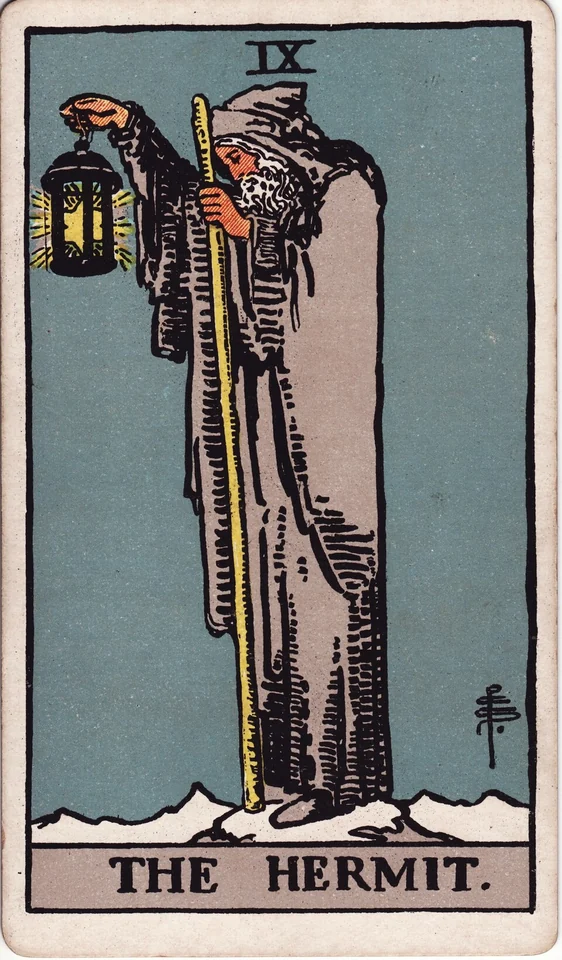
The Hermit is often pictured alone on elevated ground, holding a lantern. In a reflective practice, you might first notice solitude, limited light, age, height, distance, or deliberate movement. Another person may notice the cold landscape or the way the lantern illuminates only the next part of the path.
Those observations can open different questions: “Where would quiet help me hear more clearly?” “What do I know well enough to take one step, even without seeing the whole route?” “Am I choosing restorative solitude, or am I withdrawing from support I need?” None of these questions is the card's command.
A grounded journal entry might distinguish between solitude and isolation, name one situation where you need less noise, and choose to spend ten quiet minutes thinking before asking a trusted person for input. The image helped shape the inquiry; real context shaped the decision.
Questions that preserve agency
Reflective questions are most useful when they are open, specific enough to answer, and connected to your actual experience. Avoid questions that invite unsupported certainty about the future or someone else's mind. “What conversation am I avoiding?” offers room for honest inquiry. “Will this person return?” asks the card for information it cannot responsibly provide.
Write in plain language. Describe the situation, the image that caught your attention, the possibility it raises, and the evidence you have. If the reflection suggests action, check that action against your values, responsibilities, safety, and the perspectives of people you trust.
A guided spiritual journal can place this optional card step inside a wider practice that also includes wisdom, reflection, and intention. The card stays one prompt among several rather than becoming the source of every answer.
Which detail in the image has my attention, and what does my reaction reveal about the present moment?
Does the card suggest a viewpoint, need, strength, or tension I have not considered yet?
Separate your choices and boundaries from outcomes or other people's decisions you cannot control.
Name one small action supported by reality, values, and sound judgment rather than symbolism alone.
Know when to put the cards down
Skip card reflection when you feel emotionally flooded, when an image is likely to intensify obsessive thinking, or when you are seeking certainty about a high-stakes medical, legal, financial, safety, or relationship decision. Use reliable information and qualified help for decisions that require them.
Do not use a card to diagnose yourself or another person, confirm suspicions, communicate with someone without their consent, or justify ignoring direct evidence. A symbol can help you formulate a question; it cannot establish facts that are otherwise unknown.
Spiritual Trailhead's planned card reflection is optional, non-predictive, and subordinate to personal agency. People on the Christian path can leave it off entirely. People on the Open path can also skip it. The spiritual journaling guide offers many non-card ways to reflect when direct writing is the better fit.
A few trail markers
Clear answers for beginning gently and using the practice in a grounded way.
Ask a different question →Yes. You can treat a tarot card as a collection of images and themes that helps you notice associations, questions, and perspectives. This approach does not require fortune-telling, predictions, or claims that the card carries spiritual authority.
Describe what you literally see, notice your first honest reaction, choose one image or theme that connects with your life, write about the question it raises, and close with a practical response that remains your choice.
No. Traditional meanings can provide context, but you can begin with visual observation and a guidebook. Avoid treating a memorized meaning as a fixed verdict about your future or character.
Pause and step away. You never have to continue with a card. Return to direct observation, choose a non-card reflection, talk with someone you trust, or seek appropriate mental-health support if anxiety is persistent or intense.
No. Tarot or oracle reflection is optional and is never automatically added to a path. The Christian and Open paths remain distinct, and each person chooses whether symbolic card reflection belongs in their practice.
No. Spiritual Trailhead does not use cards for prediction, warnings, fixed outcomes, or spiritual commands. The planned tool uses optional imagery as a prompt for self-reflection and journaling.
A daily practice for your inner life
Spiritual Trailhead is being designed as a guided spiritual journal with Christian and Open paths, optional tarot reflection, and private journal history.
Reservation request only · No payment today · Spiritual Trailhead is still in prelaunch